
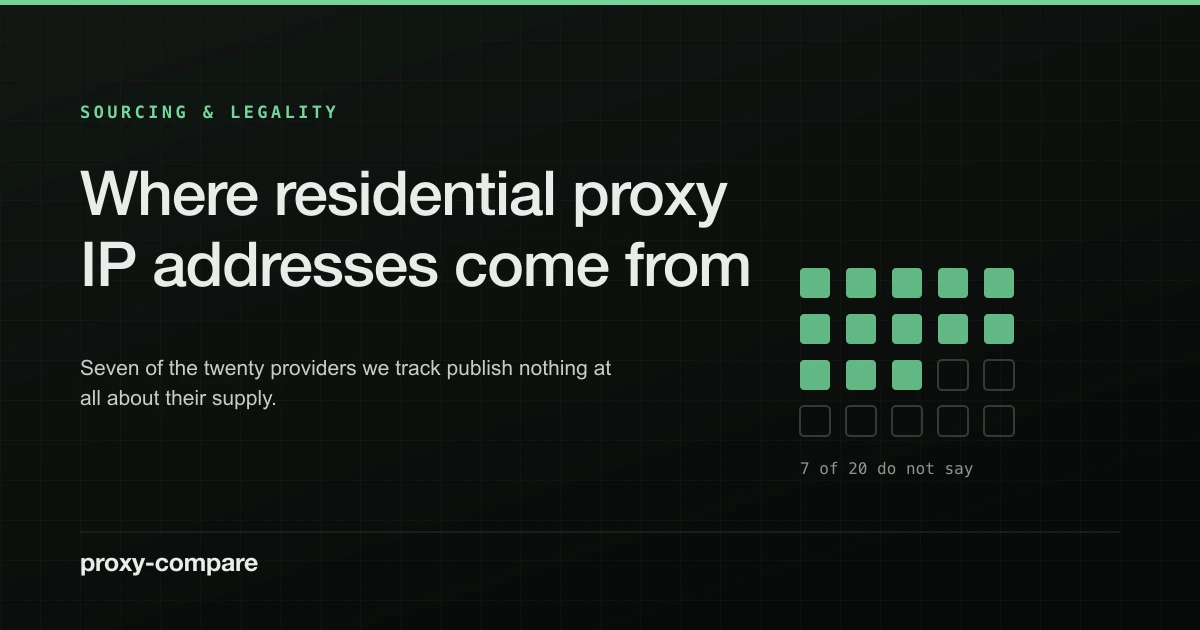
Where residential proxy IP addresses actually come from
Every residential proxy address is somebody's home connection. Proxy Compare reads all 35 proxy sellers it tracks and records how those households were recruited wherever it can: 14 have a channel on record and 21 publish nothing at all, read 5 Oct 2026. We record the silence rather than leaving the field blank.
How we check · report a mistake
Every address in a residential proxy pool belongs to a real household, a phone on a home network, a laptop, increasingly a smart TV. Understanding proxy supply matters when you are choosing a provider, because the recruitment method is the fact most predictive of whether that network becomes an enforcement story.
On this page (3)
The supply side is a consumer market
There is an entire category of apps whose pitch to consumers is: let us resell your unused bandwidth and we will pay you for it. They advertise openly, they have review sections, and people install them deliberately.
The demand for those apps is not small. Honeygain, one of the better-known bandwidth-sharing apps, measures around 6,000 searches a month, more than every proxy vendor we track except the top five. The supply side of this market has more public interest than most of the sellers do.
And a large part of it is not deliberate
The other route is a bundled SDK inside a free app, where sharing bandwidth is a clause rather than the product. This is where the volume is, and where the enforcement is: reporting on the NetNut seizure describes roughly two million consumer devices, largely smart TVs, enrolled with little or no meaningful consent.
A smart TV is a useful thing to think about here. It is always on, it is never audited by its owner, it runs software nobody updates, and its terms were accepted once during setup.
What the providers we track will say
We record each provider's sourcing model from its own public statements, and we record silence as silence. The table below is the current state across every provider on this site.
What the 42 providers we track disclose
| Bundled SDK8/42 | Webshare, Decodo, SOAX, Oxylabs, Bright Data, NodeMaven, Massive, Infatica |
| Paid app4/42 | IPRoyal, DataImpulse, PacketStream, ProxyRack |
| Datacenter2/42 | Rayobyte, PrivateProxy |
| They do not say28/42 | Mangoproxy, RapidProxy, Proxidize, Swiftproxy, NiuProxy, Proxy-Seller, ProxyScrape, Geonode, 9Proxy, Storm Proxies, Shifter, Evomi, IPBurger, ASocks, Proxy-Cheap, Thordata, ProxyEmpire, Froxy, Pia S5 Proxy, Gonzo Proxy, Crawlbase, Firecrawl, ScraperAPI, Scrapfly, ScrapingBee, ZenRows, Fleetproxy, SearchApi |
“They do not say” is a finding, not a missing value, it means the provider publishes no statement, not that we did not look.
Questions
Do people know their connection is being used as a proxy?
It depends entirely on the model. Someone who installed a paid bandwidth-sharing app knows and is being paid. Someone whose smart TV shipped with a bundled SDK very likely does not.
How do I find out where a specific provider gets its addresses?
Ask them directly and get the answer in writing before you buy. We publish what each provider states publicly, but a provider that publishes nothing may still answer a sales question, and that answer is worth having on record.
The rest of this section
- Are residential proxies legal?
- How residential proxies actually work
- Bundled SDK or paid app: what the household actually agreed to
- What regulators and prosecutors have actually done
- What proxy vendors disclose, September 2026, what actually happened
- The FBI seized NetNut. What it means if you were a customer, what actually happened
These pages carry no affiliate links, ever, including to providers they name. How this site pays for itself.