
How to use Camoufox with a proxy
Proxy Compare installed Camoufox 0.5.5 on 27 Aug 2026 and ran it against three pages, then ran headless Chromium 148 against the same three by the same method, counting every response and summing the bytes. Camoufox is a Firefox build, so what it costs on metered bandwidth is its own number.
29 Aug 2026 · 6 min read
Point in time. The figures below were read on 27 Aug 2026 and are not updated after publication. For current numbers see the comparison table.
What is Camoufox?
Camoufox is a custom build of Firefox made for scraping, driven through a Playwright-compatible API. If you have used Playwright, the code will look familiar; the browser underneath is not Chromium.
What separates it from the stealth patches is where the spoofing happens.
Tools like playwright-stealth inject
JavaScript into a page to overwrite the properties that give a headless browser
away. That works until something reads those properties in a way the patch did
not anticipate, or notices that they have been overwritten at all. Camoufox
changes them in the browser's own C++ source, so from JavaScript there is nothing
to notice: the values are simply what the browser reports.
It also generates a fresh, internally consistent fingerprint per launch rather than editing one field, and it ships with uBlock Origin enabled. Both of those have consequences worth knowing before you commit to it, and both are below.
What it looks like running
Headed, on our own site, so you can see what you are actually launching:
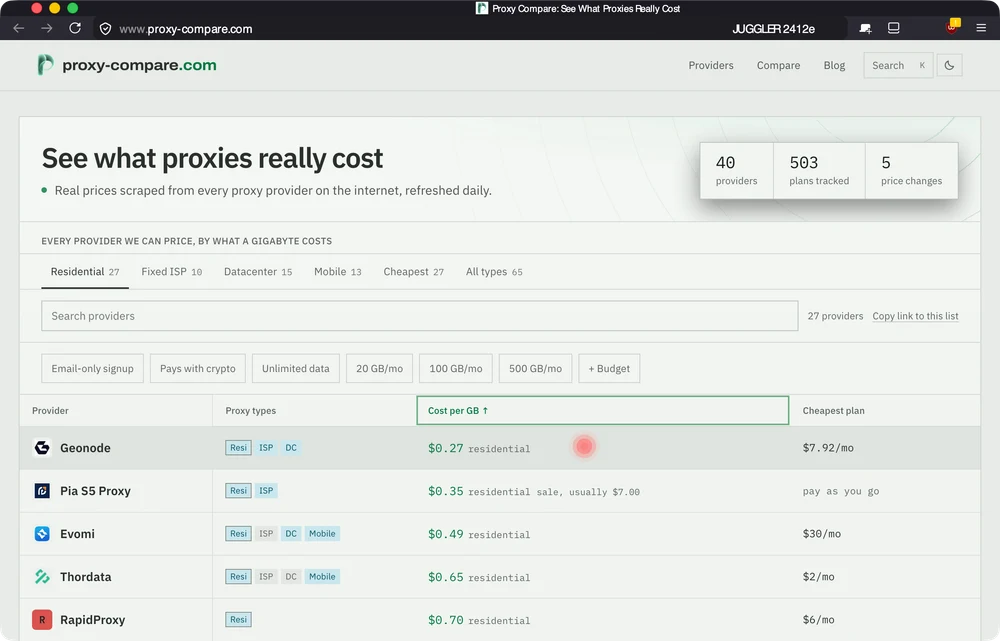
That is Firefox chrome, not Chrome's. No tab strip in the Chromium style, a
shield in the address bar, and JUGGLER 2412e in the title, which is the
automation protocol Camoufox speaks in place of the DevTools Protocol. macOS
reports the window as belonging to an application called Camoufox, not to
Chrome or Chromium.
Worth knowing before you commit: anything you have written against the Chrome DevTools Protocol does not carry over. The Playwright API does, which is the whole point of the compatibility layer, but a raw CDP call has nothing to talk to here.
Installing it
pip install camoufox[geoip]
camoufox fetch
from camoufox.sync_api import Camoufox

proxy = {"server": "http://gate.example.com:7000",
         "username": "user-session-abc123",
         "password": "secret"}

with Camoufox(headless=True, proxy=proxy, geoip=True) as browser:
    page = browser.new_page()
    page.goto("https://example.com")
Pass geoip=True whenever you pass a proxy. It sets timezone and locale from
the exit address, and without it you get a browser claiming one country while its
address says another, which is a contradiction anything can read.
The camoufox fetch step downloads a browser build and uBlock Origin, and it is
the reason the bandwidth question below has a surprising answer. Since you are
paying by the gigabyte, we measured what it costs to run.
On pages without trackers it moves the same bytes as headless Chrome. On a page with trackers it moves fewer, and the reason is not the fingerprinting.
The test setup
Camoufox 0.5.5, browser build 152.0.4-beta.29, against headless Chromium
148.0.7778.96, on the same three pages by the same method: attach a handler to
every response, sum Content-Length, wait for the network to go idle.
from camoufox.sync_api import Camoufox

with Camoufox(headless=True) as browser:
    page = browser.new_page()
    page.on("response", record)
    page.goto(url, wait_until="networkidle", timeout=90_000)
| Page | Chromium | Camoufox |
|---|---|---|
| Wikipedia article | 35 requests, 402 KB | 34 requests, 399 KB |
| books.toscrape.com product | 11 requests, 73 KB | 11 requests, 73 KB |
| webshare.io pricing | 78 requests, 621 KB | 45 requests, 532 KB |
The first two are a dead heat. The third is not, and the difference is thirty three requests that Camoufox never made.
Where the saving comes from
Camoufox ships uBlock Origin and turns it on. Its installer downloads the addon as a named step, which is easy to miss because it scrolls past in a progress bar.
That is the whole difference. Wikipedia and a static bookshop page carry nothing for a blocker to block, so both engines fetch the same things and move the same bytes. A commercial pricing page carries analytics, tag managers and ad infrastructure, and Camoufox drops them before they reach the wire.
Spoofing a fingerprint costs nothing in bandwidth and saves nothing either. It changes what the page is told about you, not how much of the page you fetch. If you are choosing an anti-detect browser to save money, you are choosing it for the blocker, and you could have had the blocker anyway.
What it costs
At the rates we hold on 27 August 2026, ten thousand pages at the Wikipedia weight of 399 KB is about 3.8 GB:
| Residential, median $2.45/GB | Residential, cheapest $0.27/GB | |
|---|---|---|
| 10,000 pages at 399 KB | $9.32 | $1.03 |
| 10,000 pages at 532 KB | $12.43 | $1.37 |
Both columns are residential rates, because that is what an anti-detect browser is usually pointed at. The gap between them is nine times. The gap between running a browser at all and fetching documents only is far larger, and we measured that separately: the same Wikipedia article is 46 KB as a document against 399 KB rendered.
So the order of operations is unchanged by which browser you pick. Decide whether you need a browser at all, then decide which one.
The caveat, because it changes how you should read the table
Content-Length is missing on some responses, so every figure above is a
floor. The counts were 0 uncounted responses on Wikipedia, 9 of 11 on the
bookshop page, and 21 of 45 and 38 of 78 on the pricing page. Chunked responses
do not carry the header, so the two heavier rows undercount both engines.
The Wikipedia row is the only fully counted comparison, and it is the one the headline rests on: 402 KB against 399 KB, with every response counted on both sides. The other two rows are directionally useful and are not precise.
We are publishing the limitation rather than a cleaner number, because a cleaner number would have meant reading bytes off a proxy we were not running the traffic through.
Setting a proxy
Camoufox takes a proxy the same way Playwright does, as a dict, and geoip=True
asks it to match the spoofed timezone and locale to the exit address rather than
to your machine:
from camoufox.sync_api import Camoufox

proxy = {
    "server": "http://gate.example.com:7000",
    "username": "user-session-abc123",
    "password": "your-password",
}

with Camoufox(headless=True, proxy=proxy, geoip=True) as browser:
    page = browser.new_page()
    page.goto("https://example.com")
Two things about that credential are worth knowing before you paste one in, and neither is in the tool's documentation because neither is the tool's fault.
The session token does not sit in the same field at every provider. Some put
it in the username, as above. Others put it in the password. Paste the wrong
shape and the endpoint answers 407 with nothing in the error naming the cause.
Some providers do not take a username and password at all, and expect the IP you are connecting from to be on an allowlist instead. Credentials sent to one of those fail the same silent way.
We record what each provider states about both on its provider pages, with the date we read it and a link to the page we read it on. Where a provider says nothing, the page says that rather than guessing.
Limitations
We did not run this through a proxy. Every measurement above is a direct connection, which is the right way to measure page weight and the wrong way to measure anything about a provider. We did not test whether Camoufox evades any particular anti-bot system, because that changes weekly and a dated claim about it would be worth less than the space it took.
What holds is narrow and checkable: on 27 August 2026, at these versions, an anti-detect browser cost the same to run as a normal one, except where its bundled blocker saved requests.
Sources
- Camoufox PyPI, read 27 Aug 2026
camoufox 0.5.5
Questions
Does an anti-detect browser use more bandwidth than a normal one?
Not in our measurement. Camoufox and headless Chromium moved the same bytes on pages without trackers, 399 KB against 402 KB on a Wikipedia article and 73 KB each on a small product page. On a page carrying ads and analytics, Camoufox moved less, because it ships uBlock Origin and blocks requests Chromium makes.
Does Camoufox reduce my proxy bill?
Only on pages that carry trackers, and only because of the bundled blocker rather than anything to do with fingerprinting. Spoofing a fingerprint costs nothing in bytes and saves nothing either. Every asset you do not block still crosses the meter.
How much does a Camoufox run cost on a residential proxy?
At the time of writing, ten thousand Wikipedia-sized pages is about 3.8 GB, which is roughly $9 at the median residential rate we track and about $1 at the cheapest. The variable that moves it is page weight, not the browser.